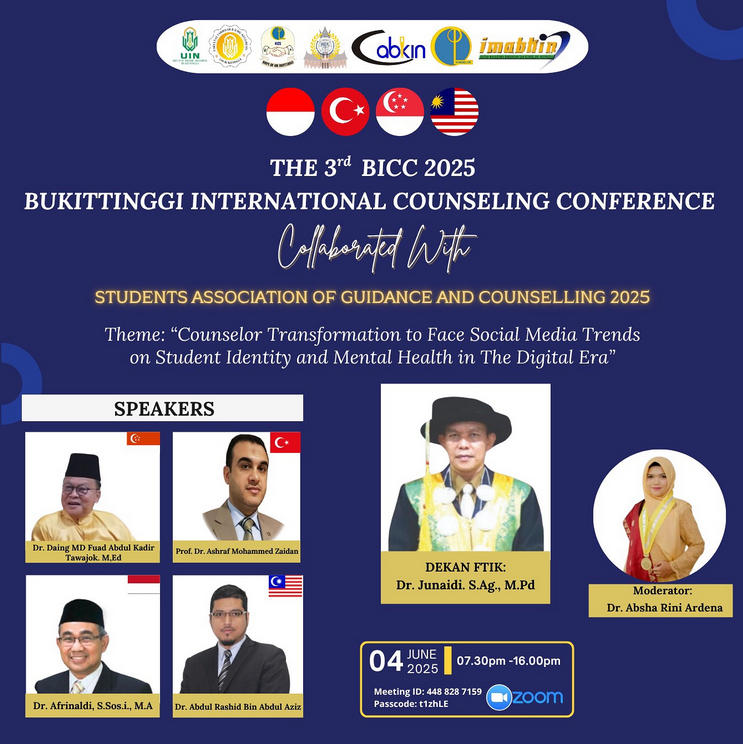
Counselors in the Digital Age: Strategies for Facing Social Media Challenges to College Students' Mental Health
Keywords:
counselors, digital era, social media, mental health, studentsAbstract
In today's digital era, social media has become an inseparable part of students' lives, providing various benefits as well as challenges related to mental health. Intensive use of social media often causes psychological pressure, such as anxiety, stress, depression, and self-image disorders due to the phenomena of social comparison, cyberbullying, and digital addiction. In this context, the role of counselors becomes very important as the front line in helping students deal with the negative impacts of social media and build healthy mental resilience. Counselors in the digital era adopt various innovative strategies, including digital literacy education to increase students' awareness of healthy and responsible use of social media. In addition, counselors provide emotional support through face-to-face and online services (cyber counseling), helping students manage stress and anxiety that arise due to digital pressure. Counselors are also actively developing online and offline mental health campaigns, as well as providing special interventions for victims of cyberbullying with effective coping strategies. The complex challenges in the digital era require counselors to continue to improve their technological competence, collaborate with other professionals, and utilize creative media such as educational videos and digital platforms to expand the reach of services. Thus, counselors are not only providers of psychological services, but also educators and advocates of mental health who are adaptive to digital dynamics. This study confirms that the integration of technology and a humanistic approach in counseling practice is the key to success in maintaining students' mental health amidst the increasingly strong influence of social media.
References
Arsyad, A. (2019). Digital learning media in guidance and counseling services. Journal of Educational Innovation, 3(1), 45-60.
Al Hajri, I., Mahdum, & Khadijah, K. (2024). Development of Instagram social media for guidance and counseling laboratories in optimizing cyber counseling services. SAKOLA: Journal of Science Cooperative Learning and Law, 1(2), 854-870.
Badrujaman, Imawati, & Fadhillah. (2019). Overview of the implementation of online counseling services in higher education. Journal of Education and Counseling, 5(2), 100-115.
Dewi, L. P. (2020). Overcoming social media addiction in adolescents through guidance and counseling services. Journal of Psychology and Counseling, 8(3), 56-68.
Hasan Basri. (2019). Implementation of cooperation values in Islamic guidance and counseling. Journal of Islamic Psychology and Education, 7(1), 80-95.
Lestari, N., & Asmadi, A. (2020). The relationship between social media use and self-compassion on self-esteem of nursing students. Indonesian Health Journal, 9(3), 123-130.
Muhammad Yusuf. (2020). BK teacher strategies in increasing positive cooperation in schools based on QS. Al-Maidah:2. Journal of Islamic Education and Counseling, 8(3), 150-165.
Pratiwi, A., & Nurwahidin, M. (2021). Improving student counseling through asynchronous chat-based cybercounseling at the University of Lampung. SIGMA-Mu: Journal of Islamic Guidance and Counseling, 13(2), 36-50.
Maharani, I., Fridani, L., & Akbar, Z. (2019). The effectiveness of using themed film media in guidance and counseling services. Student Journal of Guidance and Counseling, 1(1), 164-175.
Prihatiningsih, R., & Simon, J. A. (2024). Self-disclosure through social media for guidance and counseling students at Universitas PGRI Madiun. Bikoling: Journal of Guidance and Counseling, 7(2), 45-58.
Prasetyo, E., & Nurwahidin, M. (2023). Strategy for Islamic-based cyber counseling guidance and counseling services. Journal of Islamic Counseling, 4(1), 55-70.
Rimayati, E. (2023). Cyber counseling: Trends in digital-based guidance and counseling services. Journal of Educational Innovation, 5(2), 75-90.
Sari, D. P., & Nugroho, H. (2022). The role of counselors in dealing with the challenges of social media on students' mental health. Journal of Educational Psychology, 10(1), 30-45.
Wahyuni, R. (2020). Positive cooperation model in high school guidance and counseling. Journal of Islamic Education and Counseling, 6(2), 120-135.
Yulianti, D., & Prasetyo, E. (2021). Overcoming social media addiction in adolescents through guidance and counseling services. Journal of Counseling and Education, 9(1), 20-35.
Downloads
Published
How to Cite
Issue
Section
License
Copyright (c) 2025 Nazifah Nazma, Alvida Fatma Ritonga, Saskia Martha Ramadhan, Seskia Fitri, Nilda Anggraini, Kukuh Dwi Sastra

This work is licensed under a Creative Commons Attribution-ShareAlike 4.0 International License.